Trajan’s Arch in Ancona
The major public works built by Trajan had a practical purpose: they were vital infrastructures, primarily for military purposes and then to facilitate trade: roads, bridges, ports, and aqueducts.
But at the same time, they served for imperial propaganda: they celebrated the emperor's exploits and greatness, as in the case of Trajan's Column and various triumphal arches dedicated to him, some of which have disappeared, such as the one in Trajan's Forum in Rome, which is mentioned in ancient sources.
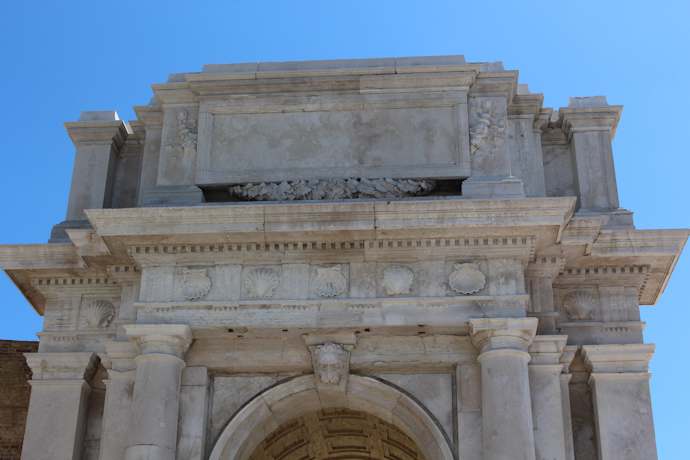
Trajan's Arch in Ancona was built to commemorate the enlargement of the city's port, which Trajan undertook at his own expense to make it safer, just as he had done in Rome by expanding the port of Claudius at Ostia, which had been devastated by a storm.
The inscription on the Arch of Ancona states that the Roman people dedicated it to Trajan because «he restored the safest entrance to Italy for sailors, having also expanded this port with his money».
It was likely designed by Apollodorus of Damascus, the builder of Trajan’s Forum in Rome. It was located near the ancient Roman port, of which nothing remains, and stands on a high podium preceded by a staircase on both sides.
The dedicatory inscription recalls that Trajan held the titles Germanicus and Dacicus, because he had defeated the Germans and Dacians, so it must have been built several years after the 100 AD, the date of the expansion of the port. Therefore some scholars believe that after the conquest of Dacia, the arch's inscription was modified or added to, decorating it with other bronze statues and friezes, which were later removed and melted down by the Saracens.
Along with the port of Ravenna, which housed the military fleet, the port of Ancona became one of the most important ones in the Adriatic sea: Trajan's two great expeditions against Dacia departed from it, as documented by one of the scenes on Trajan's Column.
Trajan’s Arch in Benevento
 It is one of the best-preserved arches in the Roman world, and like the one in Ancona, it was built to commemorate an important public work: the construction of the via Traiana, which connected Benevento with Brindisi, providing a commercial outlet for the agricultural products of the city and its surrounding area.
It was built between 114 and 117 AD, in the final years of the emperor's reign. Over the centuries, various buildings were built around it, and were demolished in the late 19th century during one of the many restorations.
On the outside, on either side of the arch, are two winged Victories, and on the attic is a dedicatory inscription commemorating the emperor with his honorific titles of Optimus, Germanicus, and Dacicus.
The two facades are richly decorated with reliefs depicting Trajan's triumphal procession for the victory in Dacia, the creation of the Alimenta, the founding of the provincial colonies, and recall many other positive things that the emperor had done for the city and the Empire as a whole.
Inside the archway are two large bas-reliefs depicting Trajan being welcomed by the Capitoline Triad or Trajan in the Forum Boarium. Due to their high artistic quality, they have been attributed to the anonymous sculptor of Trajan's Column, the "Master of Trajan's Enterprises."
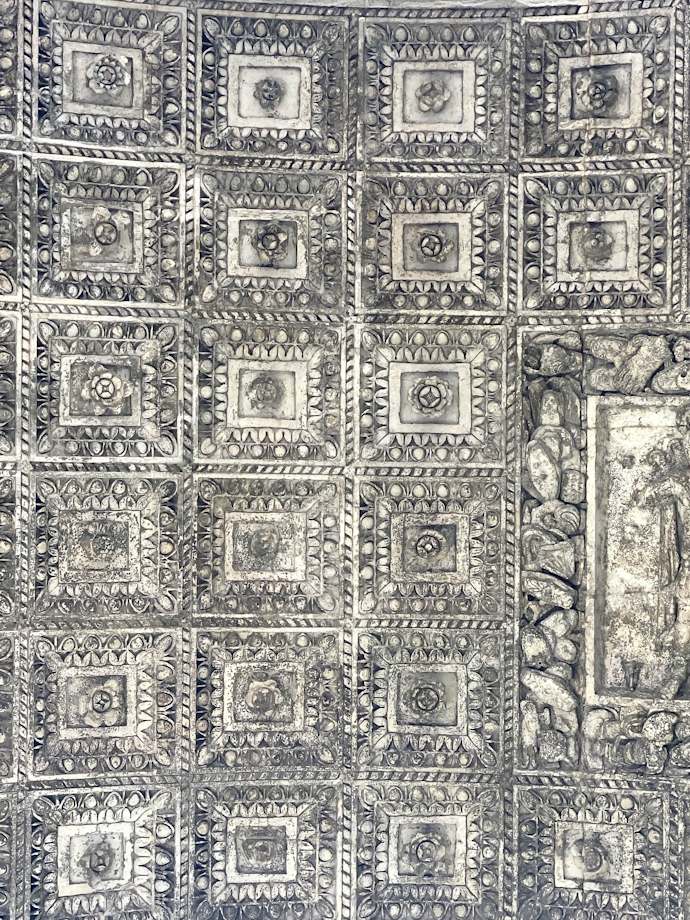
The archway is decorated with square coffers with rosettes, reminiscent of those on the Arch of Titus in Rome, and features a winged Victory crowning the emperor at its center.