At the beginning of the visit of Hadrian's Villa, there is the very long wall of the Poecile, which borders on the north side an enormous garden surrounded by porticoes with a central water basin, wherethe landscape and surrounding buildings are reflected.
The name was created in the sixteenth century by Pirro Ligorio, who identified this building as the Poecile mentioned in the famous description of Hadrian's Villa found in the Historia Augusta. It was inspired by the Stoa Poikile, built in the mid-fifth century BC in Athens: it was one of the porticoes of the Agora, famous for its paintings, the place where Stoic philosophers gathered.
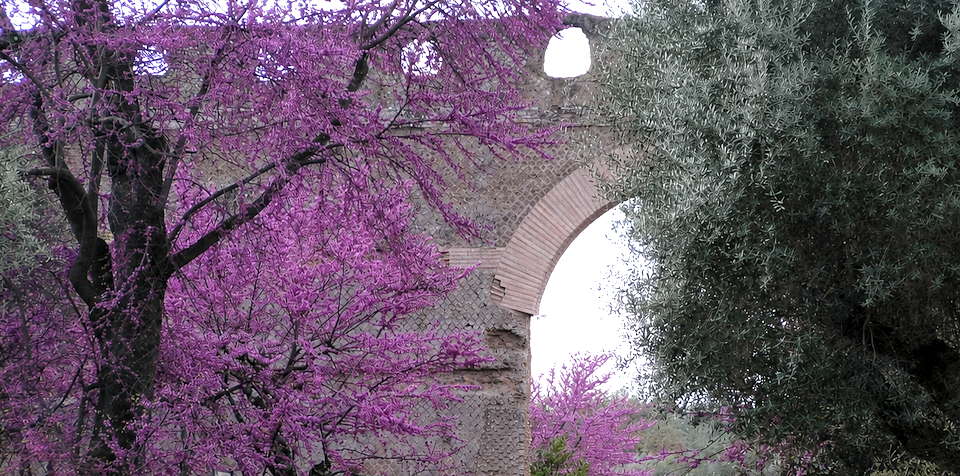
The wall is over three hundred meters long and originally had a double portico on both sides; at the top there are the holes for the beams that supported the roof, but everything else has disappeared; nothing remains of the floor, much less of the frescoes that must have decorated the walls.
In late antiquity, the large inner garden was divided into several land plots and planted with vines and olive trees. Cultivation destroyed everything, and probably the marble of the pavement was burned to make lime.
The side of he double portico towards the inner garden with the water basin is facing south: people could walk there in the winter because it was always heated by the sun and therefore warmer and more sheltered.
In summer, however, people could walk on the outer, north-facing side, which is always shaded and much cooler; this is still the case today when temperatures are high.
At the eastern end of the double portico, a double staircase still leads to the Hall of the Philosophers, which was likely the Villa's Throne Room (see other posts on this topic). We know that it was decorated with precious marbles such as red porphyry, the imperial stone par excellence.
The large garden of the Poecile with its water basin is a vast artificial esplanade supported by grandiose substructures about twenty meters high, known as the «Hundred Chambers» for their large number of windows.
The rooms inside the substructures were divided into multiple levels by mezzanines, had multiple latrines, and opus spicatum pavements, typical of the buildings housing the Villa's service personnel, namely slaves and soldiers. The back wall had a cavity to insulate them from humidity. They are currently used as a storage area.
The Hundred Chambers were bordered by a sunken driveway, coming from the via Tiburtina, which entered the Villa's subterranean service corridors (also closed to visitors). This allowed the slaves to access the heating systems of the Great Baths and Small Baths without being seen.
Next to it is another road with the remains of a portal that led to the Paved Roadway (Anello Basolato), one of the monumental entrances to the Villa and functioned as a roundabout.
In practice, carriages traveled along one side of a long, narrow double avenue, reached the Vestibule stair, disembarked the emperor's guests, and then continued along the opposite side. This ensured continuous carriage circulation; a large Tower, conveniently located in front of the portal, also served to guard and protect the entrance.