Trajan's spectacular Alcantara Bridge was a public work of enormous importance, a true investment for the future. It was built over the Tagus River in the Roman province of Lusitania, whose capital was Augusta Emerita, now Merida in the Spanish region of Extremadura, home to a magnificent Archaeological Museum.
The bridge is located at a crucial point for reaching the innermost part of Lusitania and was built to exploit the region's rich mines: thanks to it, gold and silver were quickly transported to the Mediterranean coast and then reached Rome by ship. These were essential to finance the Empire's ever-increasing costs.
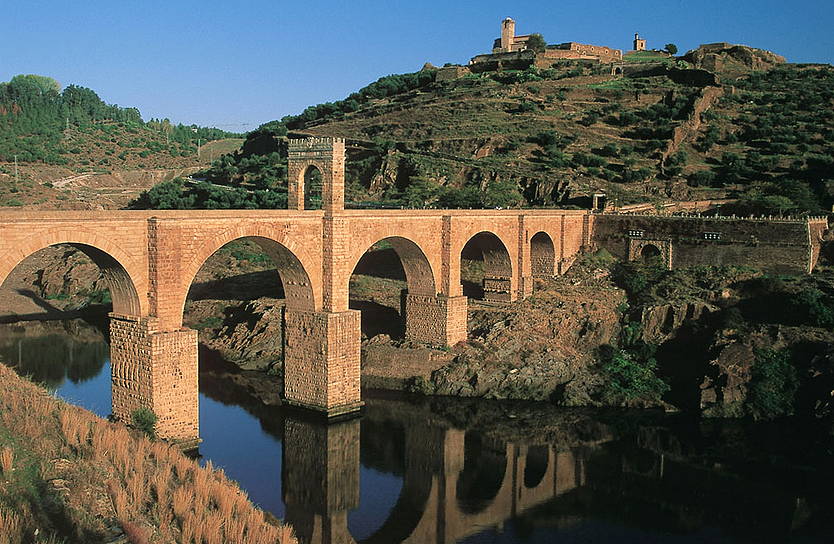
Trajan entrusted the bridge's design to the architect Caius Julius Lacer, who completed it in just a few years. He chose a location where the Tagus was narrow, 64 meters wide, making its construction relatively easier.
Recent surveys have shown that the lower part of the central piers is older, and was incorporated into the piers of Trajan's Bridge, so it is thought that an attempt to build a bridge there had already been made in the Augustan era, when the region was conquered by the Romans
Built in opus quadratum with granite blocks, it is almost 200 meters long and 8 meters wide, allowing two chariots to pass in each direction.
It has six round arches of varying sizes; the two central ones are 70 meters high, and the three piers supporting them rest on the riverbed; they have a triangular shape to cut through the river water during floods. The other arches on the side are of decreasing size to follow the contours of the rocky walls of the gorge through which the river flows, and the piers rest on the rock.
The building technique, with formwork, concrete, arches of varying sizes, and shaped piers, was imitated by Hadrian when he built the Pons Aelius (Aelius Bridge), which led to his Mausoleum in Rome. We explain this in our book, «Castel Sant'Angelo. Mausoleum of Hadrian. Architecture & Light» (English edition) which reveals its building secrets, the fruit of centuries-old Etruscan and Roman mastery in hydraulics.
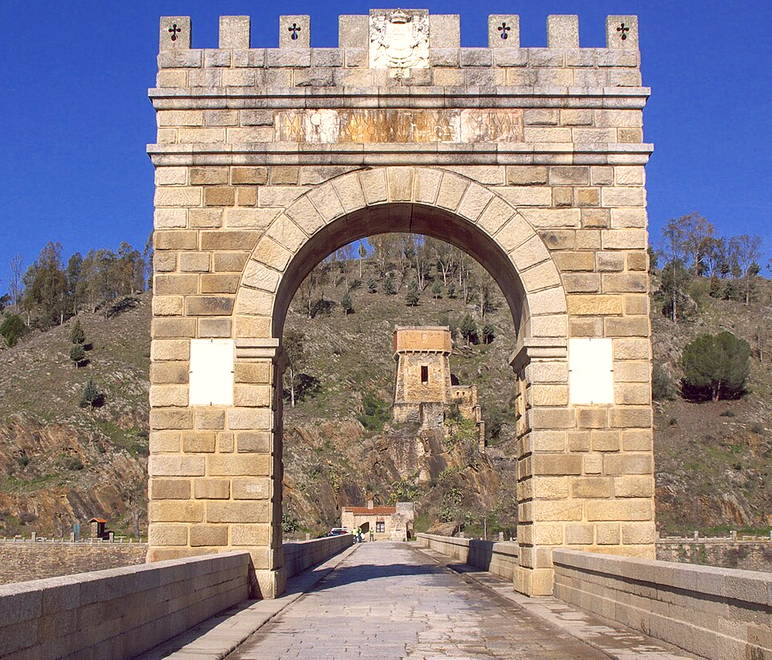
The honorary arch still visible today at the center of the bridge had a dedicatory inscription to Trajan, which dates its construction between 103 and 104 AD, a period coinciding with the emperor's public charges cited in the text. The inscription has been destroyed but is known from a transcription.
At one end of the bridge, its designer and architect, Lacer, built a small temple with an inscription that reads: «Perhaps the curiosity of travelers, whose aim is to learn new things, will ask who built [the bridge] and with what intention. The bridge, destined to last forever throughout the centuries in the world, was built by Lacer, famous for his divine art…».
Architect Lacer was convinced that his bridge would last forever, and so far he's been right, because both the temple and the bridge still exist, even though they have suffered damage and restoration over the course of nearly two millennia.
In the Middle Ages, it was fortified to control traffic, and on several occasions some of its arches were demolished to block the passage, for example in the 13th century. It was restored several times, in the 16th century by Charles V and in the 19th century by Isabella II, as can be read in their inscriptions on the arch.
Today, modern trucks pass over it, proving that Roman public works were designed to last (almost) forever.
Using stone, centuries old knowledge, and no reinforced concrete.