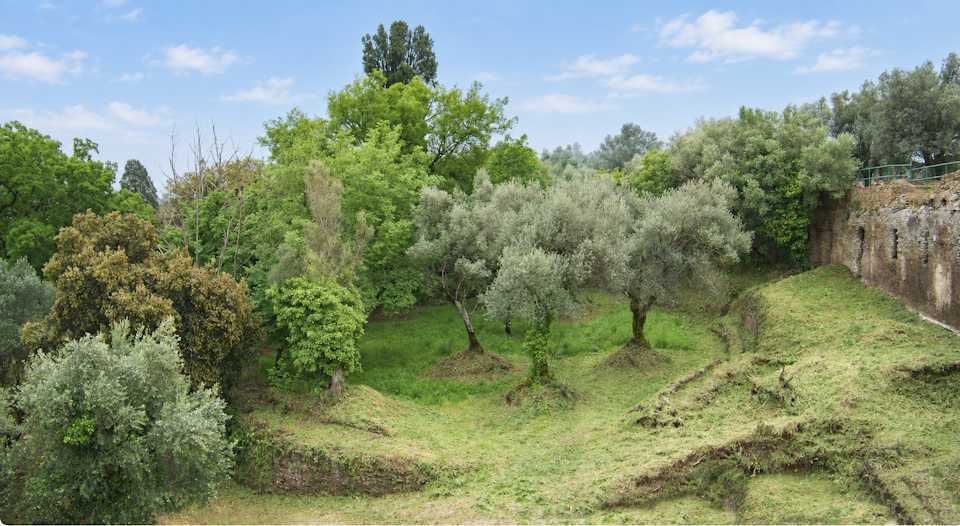
The Gladiator’s Arena is an oval masonry structure; before to the excavation, it was visible from above—looking down from the Golden Square (Piazza d’Oro) —only when it was cleared of vegetation. It has never been excavated and was traditionally interpreted as a possible gladiatorial arena or amphitheater simply because of its shape.
Since 2024, Professor Fabio Cavallero of the University of Urbino (Italy) has been directing excavations in this unexplored area of the Villa, in collaboration with the Ministry of Culture and the Villa Adriana and Villa d’Este Institute (currently directed by Dr. Alberto Samonà).
In 2024, the excavation below that oval structure the remains of a palace were found, built at the time of Hadrian—as proven by its building technique—which had been razed to the ground to make way for the so-called amphitheater.
This discovery has provided a better understanding of the Late Antique phases of Hadrian’s Villa, a period about which very little is generally known.
This year’s excavation, which began in late August 2026, led to an exceptional discovery announced in a Ministry of Culture press release: a marble slab still «in situ» bearing the inscription «FVLGVR SVBMANIVM», (lighting of Submanius) referring to an ancient Roman religious ritual.
When a site was struck by lightning, it was consecrated to the deity, and no construction was permitted there. If the lightning struck during the day, it was attributed to Jupiter; if it struck at night, it was believed to have been hurled by Submanius, an archaic deity of nocturnal sky.
The inscription therefore indicates that a lightning had struck this site during the night, and the area had been consecrated to the deity and left undisturbed thereafter.
Adjacent to it are the ruins of the palace that was razed to the ground during the construction of the so-called amphitheater.
This discovery opens up new perspectives on the study of Hadrian's Villa and its religious rituals—including those held during the Summer and Winter Solstices on the Accademia Esplanade, located on the opposite side of the villa.
On those dates, magic illuminations (hierophanies) can still be observed today in both the Roccabruna building and the Accademia building (the latter still privately owned).
Their symbolic and religious meaning, along with the associated rituals, is explained in detail in the book «Villa Adriana. Architettura Celeste. I segreti dei Solstizi» by Marina De Franceschini and Giuseppe Veneziano, published by Rirella Editrice (Italian edition only).