Part One: The Construction of the Villa.
Hadrian's Villa in Tivoli became an UNESCO World Heritage Site in 1999.
It was built by Emperor Hadrian starting in 117 AD (the date of the oldest brick stamps) as his imperial country residence far from Rome. He chose Tivoli because since several centuries it was a fashionable site for leisure, and also because of its beautiful landscape, the abundance of water and building materials such as tuff, pozzolana, and travertine.
Hadrian's Villa enclosed the remains of a pre-existing villa from the late Republican era, with walls in opus incertum, quasi-reticulatum, and reticulatum, which is thought to have belonged to Hadrian's wife, Empress Vibia Sabina.
It is the most important and complex villa of Roman antiquity, larger than Pompeii, at least 80 hectares, perhaps 120, but its boundaries have never been ascertained. The term "villa" is reductive because it was actually an immense estate with more than thirty buildings spread across several terraces. It was something unique, unmatched even by the royal palaces of Versailles, Windsor, or Caserta, to which it is often compared.
We know that the Villa was used until Late Antiquity, but after the death of Hadrian, it quickly lost importance, and it seems that Caracalla and Constantine stripped it of its marbles to reuse them in other buildings.
The discovery of portraits of other emperors after Hadrian—up to the time of Alexander Severus (222-235 AD) – proves that the Villa was still in use during the reigns of the Antonines and Severans.
The last historical record dates back to the time of Emperor Aurelian (270-275 AD), and is about Zenobia, Queen of Palmyra. She was exiled to Tivoli, on a property near Hadrian's Villa, as we know from another passage in the Historia Augusta [Tyranni Triginta, 30, 27].
Then it fell into oblivion, becoming "Old Tivoli," a convenient quarry of ready-made building materials: marble and columns for churches, bricks for buildings of medieval Tivoli.
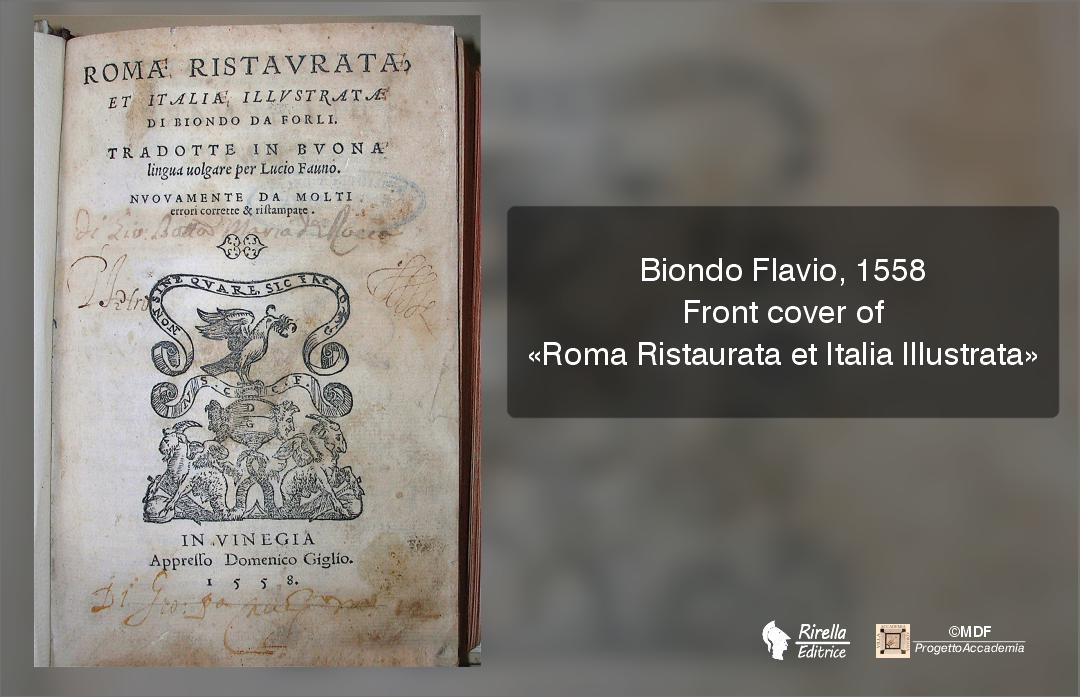
In the mid-15th century, Flavio Biondo, together with Leon Battista Alberti _ the founding fathers of Archaeology in Italy – attempted to identify the buildings described in ancient sources, four hundred years before Heinrich Schliemann did the same with the city of Troy that he rediscovered reading the Iliad.
Biondo Flavio described his discoveries in the book «Roma Ristaurata e Italia Illustrataı», published in 1558.
Flavio Biondo realized that "Old Tivoli" was actually Hadrian's Villa, described in the famous and much-quoted passage from Spartianus's Historia Augusta [De Vita Hadriani, XXVI, 1-5]:
«His Tiburtine villa was marvelously built, and he gave parts of it the most famous names of provinces and places, calling them, for example,Liceo, Accademia, Pritaneo, Canopo, Pecile, Tempe. And to leave nothing out, he even created the underworld (Inferi)».
A cryptic phrase, a puzzle that all scholars tried to solve, trying to identify the places and buildings. We know very little about the original "models": Liceo, Accademia, Pritaneo, Canopo, Pecile, Tempe. They have not survived, and we know them mostly from ancient descriptions. In the absence of sound evidence, any identification is therefore doomed to remain a hypothetical interpretation, and often a rhetorical exercise in itself.
It's important to note that according to the Historia Augusta, Hadrian «gave the most famous names of the provinces and places» to the buildings of his Villa; therefore, he did not "copy" those ancient models, as is generally believed: rather, he created new buildings inspired by older and more famous architecture.
Hadrian's Villa shares with many other famous archaeological sites the paradox of been known, excavated, and studied for over five hundred years, yet remains largely unknown in some aspects, because for centuries, antiquarian excavations were merely treasure-hunting excavations, and are undocumented. Most of the studies have an historical-artistic approach, and focus much less on architecture and archaeology.
The history of Hadrian's Villa is therefore a never-ending story; there is always something to study, learn, and discover about the symbolic meaning of its architecture, which is explained in the book of Marina De Franceschini «Villa Adriana. Architettura Celeste. I segreti dei Solstizi».