Hadrian's Villa had four different Baths, each meant for different users.
The Baths with Heliocaminus were reserved for the Court; the Small Baths and the private bath inside the Maritime Theater were for the emperor's personal use only. All three were richly decorated with marble on the walls and opus sectile marble floors.
Finally, there were the Large Baths, which had simple black and white mosaic floors; they were "large" because they were reserved for the villa's numerous staff.
The "urban legend" that the Small Baths were for women and the Large Baths for men is a fake: users differed because of social rank, not gender, as evidenced by the quality of their decoration. Precious for the court, simpler for the personnel.All Roman baths had an entrance area with a changing room (Apodyterium), from which, after undressing, one could access a cold and a hot area, following a precise route through heated rooms with gradually increasing temperatures.
The cold area had one or more cold-water pools, followed by a warm room (Tepidarium), and another hall with hot-water pools (Caldarium). Finally there was a highly heated room, a sort of SPA (Sudatio or Laconicum). Inside were braziers for steam baths and small basins on pillars with cold water (Labrum). There was also an outdoor area for gymnastic exercises, the Palestra.
The Great Baths were no exception, and being reserved for the villa's staff — that is, a large number of users — had two very large cold-water pools, once revetted with white marble.
They are inside the Frigidarium, an enormous hall that for centuries has amazed visitors because it has a part of the cross vault suspended in mid-air, defying the laws of gravity. It seems ready to collapse at any moment…. but it is not so.
A comparison with an 18th-century engraving by Giovan Battista Piranesi proves that it was already in that condition at that time. It has defied centuries and millennia, resisting weathering, looting, collapses, and earthquakes. Let's find out why.
The suspended vault is evidence of the solidity of the concrete structure, one of the most extraordinary and revolutionary inventions of Roman building techniques.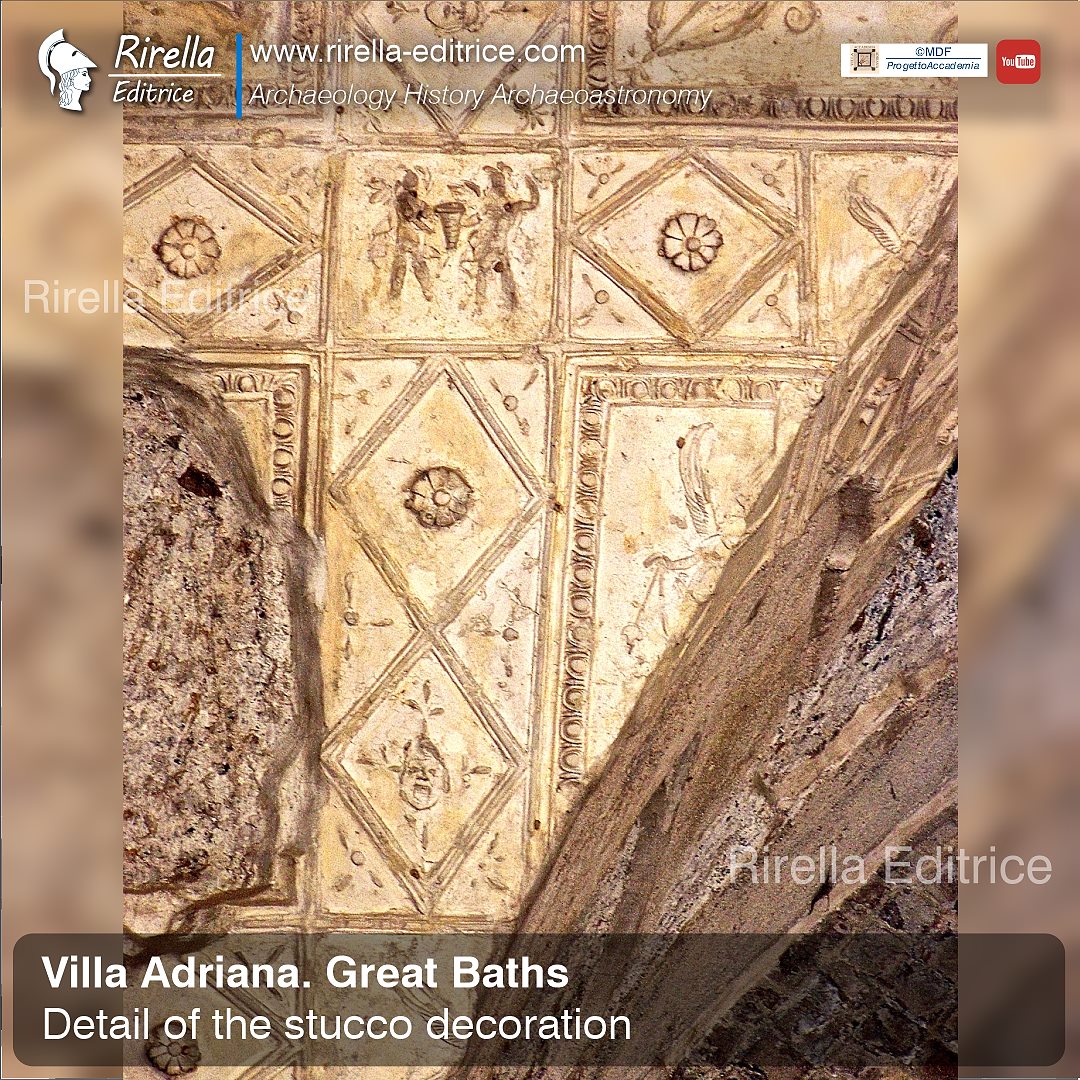 It is obviously unreinforced concrete; Vitruvius handed down the «magic formula»: a mixture of pozzolana (a natural cement of volcanic origin found in abundance in the subsoil of the Villa itself), fragments of tuff or local stone, quicklime, and river sand—essential because, being salt-free, it does not retain moisture.
Adding water to the quicklime a chemical reaction was triggered, and then the mixture was poured little by little over a wooden cast. The bricks arranged sideways, which can still be seen in the vault, served to stabilize the concrete.
Within a few days, the mixture solidified, becoming almost indestructible, as this extraordinary example demonstrates. This was done several times until the vault was completed.
The Frigidarium was the room for cold baths, with two large water basins once revetted with white marble.
The columns were made of cipollino marble with Ionic capitals.
The vault was decorated with stucco, and a portion of it survives in another room.
It seems that in the 18th and 19th centuries the English noblemen on the Grand Tour shot at the stucco to make some fragments fall down, and take them home as precious souvenirs.